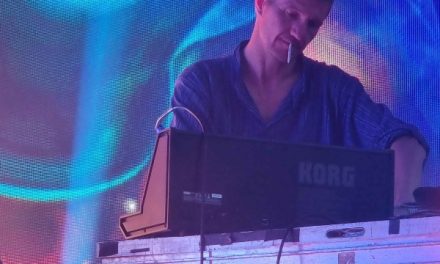

Spoonbill is the artist name of Jim Moynihan, an electronic music producer from Melbourne, Australia.
He began his musical journey as a drummer and percussionist in various bands during his youth, and by the late ’90s he had transitioned into electronic music, shifting his focus toward production.
Unexpected twists from funky, bass‑heavy grooves to dreamy ambient moments; from jazz‑tinged horns to glitchy rhythm experiments. Spoonbill’s music tends to feel like an audio‑journey or a sound‑art experience, rather than straightforward songs.
Now, after six full-length albums along with numerous EPs, remixes, and compilation appearances, he celebrates 20 years on stage.
We feel fortunate to have the chance to speak with him.
Interview by the psybient.org team on 25/02/26.
Hi Jim, how have you been? Great to chat with you.
All’s well here at MoonSpoon HQ up in the hills north of Melbourne. Keeping bonkers busy, always a stack of projects on the go!
Your artist name Spoonbill is quite distinctive. Is there a story behind it?
Yeah, we used to have royal spoonbills that would visit a dam near our house where I grew up. They always intrigued me with their quirky, spoony-shaped bills. I felt they made a jovial and suitable totem, being a bit eccentric, and a unique tangent of evolution which seemed to fit the music and the way I approach sound.
Can you tell us about your musical background? How did your journey into music begin?
I started playing drums as a kid, inspired by my older brother’s band, who used to rehearse in my dad’s studio when I was a boy. I was always stoked on the drums. As a teenager, I got deeper into percussion and then ventured into the world of hardware samplers toward the end of high school. I played in a few bands using samplers and analogue gear before launching fully into electronic music, eventually transitioning into computer-based production around the year 2000.
You’ve been making music as Spoonbill for 20 years now. How has your sound changed along the way?
Yeah, I’ve been releasing music under the Spoonbill moniker since 2005. It’s been an epic journey, and the music has naturally changed and evolved over time. I don’t set boundaries or rules, I just follow my intuition and aesthetic with my compositions, which I guess has slowly and naturally morphed over the years. That said, I think there’s still a lot of the same intention, vibe and ideology in the sound.
Your sound mixes glitch-hop, downtempo, experimental electronica, broken beat, bass music, and basically everything in between. What inspires you to blend all these genres?
I simply enjoy making music that makes sense to me in the moment. I follow what feels right, intuitively combining elements from different tones and textures to create something fresh. It’s like crafting a collage out of fragments of sound, where rhythms, melodies, and textures interact in unexpected ways. I’m drawn to the spaces between the conventional, the moments where one style bleeds into another, and I love exploring how contrasting elements can coexist and transform each other. It’s not about labels or fitting into a category, it’s about following curiosity and letting the music take its own shape.

Also, your 20-year Aussie tour just ended. How was it?
It was awesome and rewarding to share my music far and wide over the last 12 months in celebration of 20 years of releases and touring. Getting out to some remote spots was quite special, and sharing the spoonytunes with crowds who have been supportive since the early days. I have been incredibly lucky with the continued support I have received along the journey.
How do you organize your concerts and coordinate your ensemble?
It’s a mix of booking agents, advancing agents in different regions, and long-standing relationships with promoters. Bringing an ensemble together is always a small miracle, aligning the schedules of talented, busy musicians takes patience, flexibility, and a bit of faith in good timing.
Which production processes, tools, or instruments are key to the sound you create?
Cubase has been my central hub for decades. It’s where ideas are sketched, warped, and mangled. I work with a combination of hardware, soft synths and outboard gear, but a big part of my process is committing sounds to audio, then cutting, bending, and reassembling them. A single bassline might be built from many small sonic fragments, all converging to speak the same phrase.
Which musicians have influenced you most throughout your journey?
My influences are pretty wide and varied. Genres such as funk, groove, acid jazz, trip hop, big beat, glitch, and experimental noise were all formative in my early years. As was artists like Bentley Rhythm Ace, Amon Tobin, Sly Stone, Funkadelic, Mr Scruff, DJ Food, The Cinematic Orchestra, and Hermitude, among many others, have all left their imprint.

Could you tell us a bit about your work in sound design and other artistic projects outside of Spoonbill?
I’ve always been interested in sound beyond the framework of songs. Over the years I’ve worked on sound design for experimental installations and video games. One project used a depth camera to guide a virtual school of fish through a psychedelic underwater landscape. Each fish represented a musical event such as notes, chords, rhythms, and as the school grew, procedural music would emerge. With enough fish gathered, new musical zones would open, allowing you to reshape riffs and transform the synth textures making the music your own. Kind of like a DAW but skinned with a game mechanic.
When you’re not making music, what do you like to do? Who is Jim in his everyday life?
I love designing and making things. I designed and built my own house and studio from scratch, and I live in a rural setting, so I enjoy doing tons of practical things around the property. Time spent outside, even something simple like collecting firewood with the tractor helps balance the abstract, internal world of music-making.
What advice would you offer to emerging musicians? Any message for the psybient.org community?
Follow your intuition, and try your best to ignore what you think is popular or trendy. Just do what makes sense to you in the most uninhibited way possible. Be real, block out the noise, follow your own lead, and craft the sounds you truly love.
Thank you so much for your time, it’s as inspiring as your music. We can’t wait to hear what you release next and get lost in your unmistakable sonic world. Cheers!
Thanks a bunch! Best Vibes!
Jim
Listen and follow Spoonbill:

![[interview] with Bluetech – Native State Records (2009) by Igor Kauric](https://www.psybient.org/love/wp-content/uploads/Bluetech41.jpg)